Evident from the data are several key points. First, despite using 800 in/lb front springs, the spring rate at the ball joint is far less due to the motion ratios resulting from suspension geometry. The rear spring rate is actually slightly stiffer than the front. This results in very similar ride frequencies between the front and rear and gets the proportion between the front and rear about where it needs to be.
Engineering sources indicate the ARB should account for only 30% of the front spring rate but the current 1.125″ bar creates far more force than the springs. Essentially, the front suspension is dominated by the ARB and not the springs.
When the front spring rate and the front ARB rate are combined, they far exceed the rear rate. Engineering sources suggest the roll stiffness distribution % at the front should be about 5% – 10% higher than the static weight distribution. This is our first sign that the front is over-sprung. The culprits/fixes:
- The first culprit is the ARB…it needs to be smaller. Calculations suggest .875 to get the % influence closer to 50% but .93 or even 1.00″ would be a substantial improvement.
- The second culprit are the 800 in/lb front springs…could go down to 600 in/lb springs. The challenge with this approach is the front to rear ride frequency would not be within an acceptable range.
- The rear springs could be stiffer…likely accomplished by adding a leaf. Lots of work to do this and it doesn’t fix the overly high front roll bar spring rate compared the front coil spring rate.
Gemini NotebookLM Response
Note: I have been using Google’s NotebookLM heavily in developing the spreadsheets and equations to calculate the variables listed to this point. The following is NotebookLM’s response when I enter the variables and ask for a general interpretation. It is important to note the calculations are made using estimates for sprung and unsprung weights, so the interpretation below will not be perfectly accurate…but I am convinced it is also not too far off.
While the ride frequencies and mass distribution are in a healthy range for a car of this weight class, there are significant concerns regarding our Roll Stiffness Distribution and Rear Roll Center Height. These settings are likely to result in a vehicle that is very stable but suffers from severe understeer and potential “jacking” issues at the rear. Below is an engineering assessment based on our primary data and vehicle dynamics principles.
1. Ride Frequency and Phasing (The “Flat Ride” Concept)
Our ride frequencies are currently set at 1.34 Hz (Front) and 1.58 Hz (Rear).
- The Ballpark: For a sedan-based racecar, we are on the softer side of the recommended 1.5 – 2.0 Hz range. This will provide good mechanical grip over bumps but may feel “under-supported” to the driver during rapid transitions.
- Phasing: The rear frequency is 17.8% higher than the front. This is an excellent baseline. According to “flat ride” theory, the rear suspension needs a higher natural frequency to “catch up” to the front after hitting a bump, minimizing the pitching motion of the chassis. We are squarely in the recommended 10–20% split.
2. Roll Stiffness Distribution (The “Magic Number”)
This is our most critical setup error. We currently have 76.52% of our total roll stiffness at the front, while our static weight distribution is only 50.6% front.
- The Baseline: A standard engineering baseline (the “Magic Number”) is to set the front roll stiffness distribution about 5% higher than the static front weight distribution. For this car, that would be roughly 55-56%.
- The Result: At 76.52%, we have a massive forward roll stiffness bias. In cornering, the front tires will reach their limit of adhesion far sooner than the rears. The team should expect heavy corner-entry understeer that worsens as the driver tries to tighten the radius.
- Sway Bar Overload: Your notes indicate the sway bar provides 153% of the spring’s force. Primary sources caution that if anti-roll bars are significantly stiffer than the ride springs, the suspension loses its independence, causing the car to “dart” and follow bumps rather than absorbing them.
3. Roll Center Analysis and Jacking Forces
We have a significant mismatch between the front and rear roll centers.
- Front (3.26″) vs. Rear (12.00″): Our rear roll center is nearly four times higher than the front. While it is normal for the front RC to be lower than the rear, a 12-inch rear RC on a car with a 17.03-inch CG is extreme.
- Jacking Effects: Because the rear RC is high (closer to the CG), the lateral force from the tires has a significant vertical component that will try to lift, or “jack,” the rear of the car up during cornering. This raises the CG mid-corner and can cause unpredictable positive camber changes, further reducing rear grip.
- Non-Linear Behavior: Because our front and rear roll centers are so different, the Roll Axis is steeply inclined. This leads to non-linear load transfer, meaning the car’s balance will change abruptly as it takes a set, making it difficult for the driver to feel the limit.
4. Summary and Tools for Adjustment
To bring this car into a competitive window, I recommend the following steps using your Excel worksheets:
- Balance the Roll Stiffness: Use the
KφFAandKφRAformulas to recalculate anti-roll bar rates. Target a front roll stiffness distribution closer to 60% to reduce the current understeer bias. - Lower the Rear Roll Center: If the Panhard bar is adjustable, lower it. This will increase the Roll Moment Arm at the rear, allowing the springs and bars to do more of the work (elastic transfer) rather than the links (geometric transfer), which will reduce the jacking effect.
- Verify Longitudinal CG: Ensure your
COG Wheelbasemeasurement (49.62 in) is accurate. You can verify this in Excel by using theb = L * (Wrs / W)formula where $Wrs$ is the rear static load.
Sources Referenced:
- Carroll Smith: Tune to Win
- Gillespie: Fundamentals of Vehicle Dynamics
- OptimumG Tech Tips
- Mitchell: Roll Center Myths
- Fred Puhn: How to Make Your Car Handle
- Eibach Suspension Worksheet
Gemini NotebookLM Response Regarding Addressing Roll Stiffness at Rear
Prompt
I have a question for a hypothetical situation. Assume, the front and rear ride frequency are with an acceptable range, albeit a little low. Assume the front roll stiffness is too high which would be partly addressed by reducing the front anti-sway bar diameter. There seems to be two ways to really get the roll stiffness % front to rear in the correct range. One way is to increase the rear spring rate while the second way is to add a rear anti sway bar. It seems like adding a rear anti sway bar is best because that would directly influence front to rear roll stiffness. In contrast, increasing rear spring rate would negatively influence ride frequency. With the goal of correcting roll stiffness, is it better to increase rear spring rate or add a rear anti sway bar? What do the sources indicate? What are the pros and cons of each approach?
Response
Based on the provided vehicle dynamics sources, your intuition to utilize a rear anti-roll bar (ARB) to correct the roll stiffness distribution while preserving ride frequency is technically sound and aligns with professional trackside setup strategies.
In your specific scenario, the priority is to fix the Roll Stiffness Distribution (the “Magic Number”) to achieve chassis balance without compromising the ride frequency required for mechanical grip [2, p. 136; 26, p. 2].
1. The Engineering Priority: Balance (The Magic Number)
Carroll Smith’s fundamental rule for trackside setup is: “Get the damned thing balanced so that you can work with it—before you do anything else” [2, p. 136].
- The Goal: You need to shift the lateral load transfer distribution rearward to reduce front-end “plowing” (understeer) [2, p. 130].
- The Constraint: Since you noted your ride frequencies are already “a little low,” you must be careful not to unbalance the pitch mode or reduce tire compliance while chasing roll control [26, p. 1; 2, p. 139].
2. Approach A: Increasing Rear Spring Rate
While increasing the rear spring rate will increase rear roll stiffness ($K_{\phi, r}$), it does so by altering the vertical ride rate ($K_w$) [9, p. 211].
- Ride Frequency Impact: Per the Puhn formula, $f_n = 3.13 / \sqrt{\text{Static Deflection}}$ [12, p. 139]. Stiffening the springs decreases static deflection, which increases the natural frequency ($f_n$) [12, p. 137].
- Pitch Sensitivity: If the rear frequency becomes significantly higher than the front, you risk inducing a “choppy” ride or uncontrolled pitching over bumps [2, p. 68; 25, p. 2].
- Mechanical Grip: Stiffer springs reduce the time the tire spends in contact with the road over irregularities, which Carroll Smith warns can lead to the car being “harsh and choppy” and unable to put power down on corner exit [2, p. 136, 139].
3. Approach B: Adding/Stiffening a Rear Anti-Roll Bar
This is the preferred method for fine-tuning balance because it allows you to decouple roll resistance from ride resistance.
- Ride Frequency Impact: Anti-roll bars are “torsion bars” that only resist the difference in movement between the left and right wheels [12, p. 148]. In “pure ride” (both wheels hitting a bump simultaneously), the bar merely rotates in its mounts and contributes zero stiffness to the ride frequency [2, p. 67; 12, p. 149].
- Roll Control: ARBs increase roll stiffness ($K_{\phi}$) by a factor of $0.5 \cdot K \cdot s^2$ (where $s$ is link separation) [9, p. 211]. This directly alters the Magic Number without affecting the “softness” of the car in the vertical plane [2, p. 136].
- Leverage Discipline: When calculating this new rear rate, you must distinguish between Track Width (used for spring roll stiffness) and Link Separation (used for bar roll stiffness) to avoid overestimating your results [9, p. 211; July 13 Conversation].
4. Pros and Cons Comparison
| Feature | Increase Rear Spring Rate | Add/Increase Rear Anti-Roll Bar |
|---|---|---|
| Ride Frequency | CON: Increases $f_n$, potentially making the rear too stiff for grip [12, p. 140]. | PRO: No effect on ride frequency; preserves “soft” mechanical grip [2, p. 136]. |
| Roll Control | PRO: Increases roll stiffness [9, p. 211]. | PRO: Increases roll stiffness directly [2, p. 136]. |
| Corner Exit Traction | CON: Stiff rear springs can cause wheelspin and “power oversteer” [2, p. 136, 139]. | PRO: Allows rear to “squat” and maintain compliance for better bite [2, p. 136]. |
| Independence | PRO: Maintains total independence between wheels. | CON: Ties wheels together; one-wheel bumps will now transfer load to the other side [12, p. 148]. |
| Tuning Flexibility | CON: Labor intensive to swap springs and requires re-scaling corner weights [2, p. 68]. | PRO: Fast and easy to adjust or swap at the track [2, p. 67, 136]. |
5. Conflicting Claims in the Sources
There is a slight disagreement on the “starting point” for this adjustment:
- OptimumG recommends a “Ride-First” approach: choose ride frequencies first for mechanical grip, then use ARBs to “make up the difference” to reach the target roll gradient [26, p. 2].
- Carroll Smith suggests starting with the softest possible rear springs that keep the car off the track, then using front springs and both bars to balance the car [2, p. 72].
Engineering Recommendation
Following Source Priority (Smith for trackside strategy), you should add or stiffen the rear anti-roll bar.
This allows you to address the “Magic Number” (Roll Stiffness Distribution) to kill the understeer while keeping the rear springs soft enough to maintain traction and compliance over bumps [2, p. 136, 139]. Note: When designing the rear bar, ALWAYS use the Puhn Formula ($K = \frac{500,000 \cdot (D^4 – d^4)}{0.4244 \cdot A^2 \cdot B + 0.2264 \cdot A^3}$) to account for lever arm bending, especially if using the 12.5″ arms typical of our Austin Healey setup [12, p. 150].
Sources Referenced:
- Carroll Smith: Tune to Win: [Source 2, Pages 67-68, 72, 130, 135, 136, 139].
- Fred Puhn: How to Make Your Car Handle: [Source 12, Pages 137, 139-140, 148-150].
- Thomas Gillespie: Fundamentals of Vehicle Dynamics: [Source 9, Page 211].
- OptimumG Tech Tips: [Source 25, Page 2; Source 26, Pages 1-2].
- User Conversation History: [July 13 Entries regarding link separation vs track width].
Torsion Bar Rates
The following data shows the effect of torsion bar diameter and front spring rate on 1) the proportion of front roll stiffness to overall (front and rear) roll stiffness and 2) the proportion of the torsion bar spring rate to front overall spring rate. This assumes about 8.5 inch torsion bar arm lengths, a 21 inch torsion section, and a few other variables specific to my car.
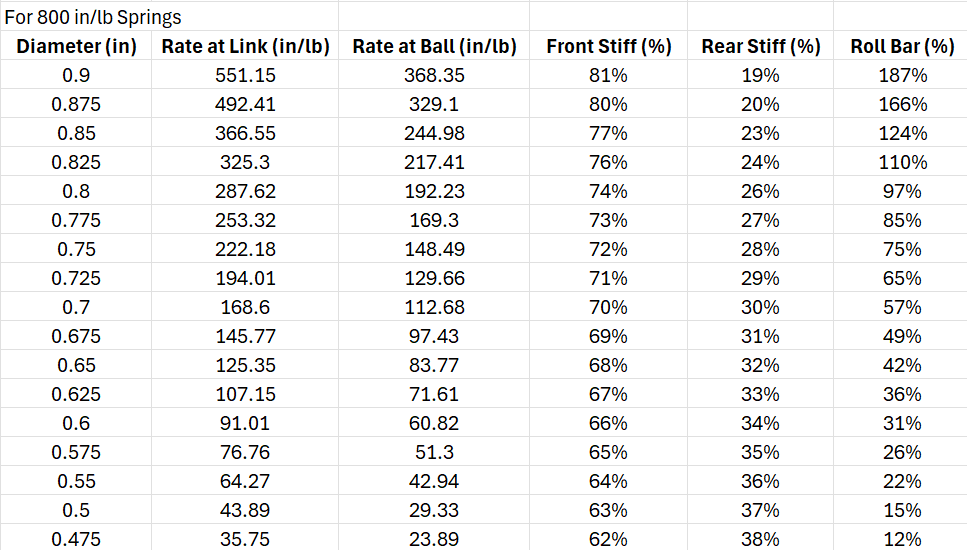
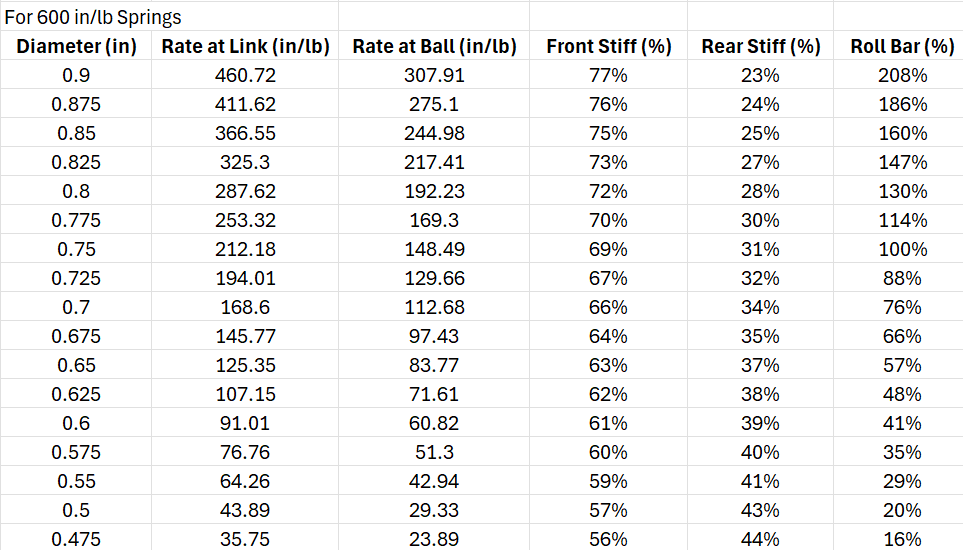
The data above is provided in the graph below. Select springs or select individual items within the legend. I am going down this rabbit hole because I am considering stitching the ARB for a torsion bar to allow for greater control over front roll stiffness.